
(3/3) You contain multitudes.
Freeing the fragmented self.

The moment that you feel that, just possibly, you’re walking down the street naked…showing too much of yourself. That’s the moment you may be starting to get it right.
— Neil Gaiman, “Make Good Art” Speech (2012)
Can I be honest with you?
I first wrote this part of the story a month ago.
Then I rewrote it. Then rewrote it again.
Then by hand. Then once more.
I think I’ve been afraid of telling myself a lie.
Or maybe of telling myself the truth.
I didn’t know the difference between the truth and the lie until this week.
Until today.
I first wrote this part of the story a month ago, but I think I’ve been trying to write it for the past two years — ever since I made the decision.
The truth (1/2).
I was making some of the best music of my life. The dream was finally starting to feel real. I was finally starting to feel real. All I had to do was finish a few songs and then it was go time. Straight to the Grammys, baby.
And then I lost my voice.
My vocal cords gave out.
My voice got weak and scratchy.
I could barely even speak.
It took months to get a doctor appointment, more months to figure out what was going on this time — I’d gotten vocal surgery a decade earlier from an injury with identical symptoms —and even more months to get my voice fully-healed.
By the time I learned that it was just a severe case of acid reflux, it had turned out to be the last straw.
The mounting financial pressure, an all-or-nothing relationship to myself as an artist, and this latest physical development made it impossible to continue.
And so, by January 2024 — after eight months and almost 200 songs — I quit.
That’s what I told myself, anyway.
It sounded good. It sounded valiant. It sounded logical.
You might have even believed it.
I did for a long time.
But it wasn’t the truth.
Not entirely, anyway.
The truth (2/2).
The truth is I quit because I was miserable.
The financial pressure, the all-or-nothing thinking, the vocal injury — all of those were real concerns that contributed to my decision to put the music down.
But the truth is, if I had really wanted to make it as a full-time recording artist, I would have made it. I would have found a way to make it work, the same as I did when I moved to Los Angeles with no experience or connections, the same as every full-time recording artist I’ve ever worked with has done.
But I was miserable.
And I was miserable because my process was a shitshow.
A shitshow with some flashes of beauty? Sure.
But a painted turd is still a turd, now innit?
In the eight months of living out my dreams as an unconstrained creative powerhouse with no responsibilities except to his craft and himself:
I didn’t finish a single song (I did start a lot — like hundreds — of them, though).
I never figured out a daily structure or routine around the music.
I struggled tremendously with the ADHD of it all.
I made it impossibly hard on myself by insisting on doing it all alone.
I was self-conscious from being isolated all day and getting no external feedback.
I felt insecure, vulnerable, and without purpose.
I was nowhere near my best self, which negatively impacted everyone around me.
I was unhealthily self-consumed, and boy is it lonely at the center of the Universe.
My fiancée likes to point out the (now) funny memory of when we first got our puppy, Theo. I was so starved for external accountability that I couldn’t wait to make a shopping list for him. Checking off mundane tasks like ordering a puppy crate provided more positive feedback than I’d encountered in almost a year.
So yeah, it wasn’t working.
Sorry kid — we have dreams at home.
Plans to get back into artist development surged to the top of my list, my artistic dreams transformed into entrepreneurial ones, and I told my inner child I’d get back to him.
That was almost two years ago. I haven’t made music since.
I hadn’t made anything since — until starting to write this series.
What does that say about me?
Am I a fraud, a phony, a failure? Am I just a suit with a spark? Have I been lying to myself for the past sixteen years? Am I the uncreative, unoriginal, unremarkable piece of plywood my inner critic has always tried to protect me from discovering?
I’d faced the demons, chased the dream, and reinvented the self. Here was a chance to take off the mask, present to the world as I truly was, publicly embrace that critical piece of me I had neglected, hidden, and outright sabotaged for over a decade.
And I didn’t. So what does that say about me?
Was my inner child just…wrong?
Who was writing the songs, then?
Who’s been writing this?
The biggest failure wasn’t in putting down the music.
I was originally going to tell you that I did what too many of us do too often: hide from our greatness, play it small, support the dreams of others and not ourselves.
But it sounded whiny. And melodramatic.
And —again— only partially true.
I like supporting the dreams of others.
I love battling on behalf of artists.
I feel blessed to have the trust of some of the most talented people I know.
And I am an artist.
The biggest failure wasn’t in putting down the music and it wasn’t in playing small. The biggest failure was in spending the past two years thinking my artist had died.
The biggest failure was in thinking I had to choose which parts of me to embrace.
My work is to stop alternating between the various parts of myself and give that orchestra we talked about in part one a reliable conductor. It’s less about chasing the dream and more about embracing the team.
But I didn’t realize that until today.
Closing thoughts.
Maybe that story didn’t end how you wanted it to. Maybe you wanted to hear about how I published the music and achieved immediate success. Maybe you wanted me to pretend like I don’t have those Grammy speeches still hiding in my drafts.
Maybe you wanted me to lie to you. Maybe you think I’m a failure.
Or maybe you’re missing the point of the story.
This isn’t a story about quitting jobs and chasing dreams.
It’s not a story about hidden talents or believing in yourself.
It’s a story about inner-conflict.
It’s a story about trying to embrace our contradictions.
It’s a story about trying to free our fragmented selves.
It’s a story about trying to becoming whole.
It’s about the multitudes contained in each of us.
And the cost we pay for compartmentalizing our parts.
Let’s wrap this up.
At 24, I quit being an artist to manage them.
At 33, I quit managing artists to be one.
At 34, I quit being an artist to manage them.
At 35, I manage artists and am one.
So, what’s different this time?
You’re reading this, aren’t you?
Thank you so much for reading this series.
It was beautiful and challenging to write.
Let’s figure this shit out together.
You a work in progress? Me too. Press subscribe and let’s figure this shit out together.
Thank you for reading,
Daniel
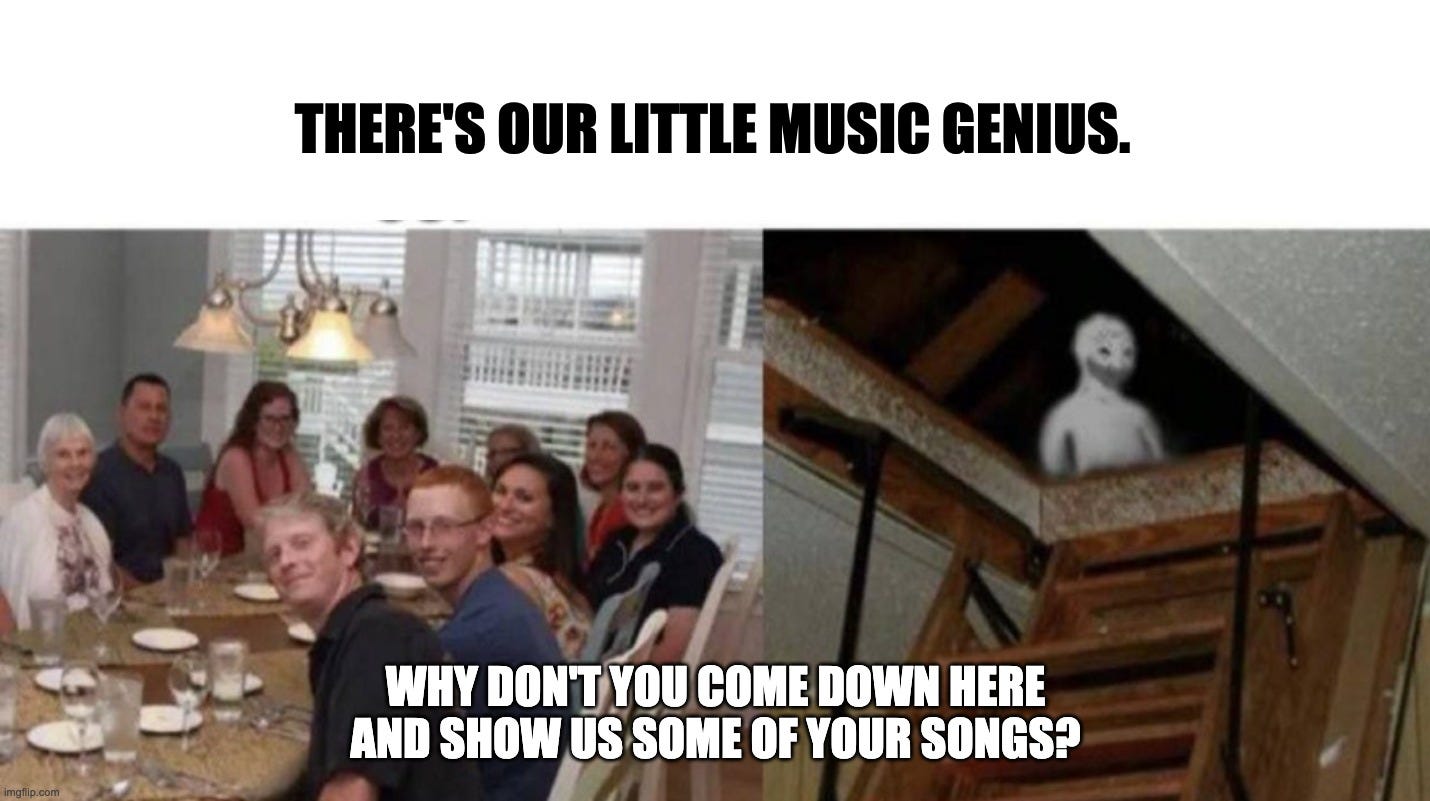
Oh my goodness this was soooo relatable. The rewrites, the almost-truths, the insecurity, the self-consciousness — I felt every bit of it.
And honestly, thank goodness we contain multitudes… because now you get to guide your clients and still be an artist. I think your inner child would think that’s cool too!
Love love LOVED this series. I found it so relatable as an artist and entrepreneur. I hope one day you share your music! Keep writing, keeping sharing!